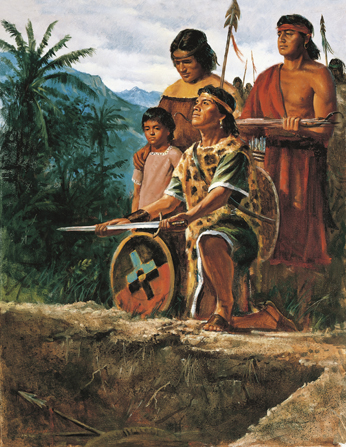
Weapons of Rebellion

lds.org
The Lamanites to whom the sons of Mosiah preached embraced the gospel and became known as the Anti-Nephi-Lehies. "For they became a righteous people; they did lay down their weapons of their rebellion, that they did not fight against God any more, neither against any of their brethren" (Alma 23:7).

We are familiar with the story of these Lamanites burying their weapons and refusing to defend themselves, leading to their slaughter and later to the two thousand stripling warriors. But I think the above verse highlights a more important aspect of their conversion. It mentions first that they stopped fighting against God, then against the Nephites. While fighting righteous Nephites is also fighting God, I believe it was referring to all rebellion against God; that is, sin. The weapons of their rebellion were not just physical weapons but also everything that fights against righteousness. Their burying their weapons was a symbolic act of their complete repentance and dedication to remain clean at all costs, even death (Alma 24:7-19). They were making a covenant with God to never return to wickedness, and they succeeded (Alma 23:6).

Challenge: Discern what your weapons of rebellion are and bury them; that is, repent and never go back to that sin again! If it helps, take an item related to the sin (or write it down on a piece of paper) and bury it in the ground. Also, remember that taking the sacrament is our symbolic act of repenting and starting anew.

Comments

DAD said…
it is my goal to do what you said
Anonymous said…
Excellent article. I agree with you completely. People need to read this. When we repent, we feel happy and clean.
Constance
Anonymous said…
And the rebellious shall be pierced with much sorrow D&C 1:3

I know this is true, for I have seen this in the lives of those that refuse to do what God has requested.
Mom

Popular posts from this blog

Family Home Evening for Babies

ldsclipart.com Family home evening can sometimes be a challenge because we don't know what to do. This is especially true for those of us with only a baby. There are plenty of ideas for single members, couples, and families, but I have yet to find good suggestions for planning a family home evening lesson for a baby (not yet in Nursery). So I compiled my own list: Read gospel-related board books. They are short and introduce common scripture stories in a very simple manner. Read the scriptures. Elder Bednar said , "Youth of all ages, even infants, can and do respond to the distinctive spirit of the Book of Mormon. Children may not understand all of the words and stories, but they certainly can feel the 'familiar spirit' described by Isaiah ( Isaiah 29:4 ; see also 2 Nephi 26:16 )." Sing Primary songs together. There is no better way to invite the Spirit, teach basic gospel principles, and prepare your baby for Nursery and Primary. Sing inte...

How to Know if the Book of Mormon Is True

photo from lds.org A previous set of elders put me on the 12-week course for new missionaries. Last night as I was finishing up the week on revelation through the Book of Mormon, I came upon this study activity: Read Moroni 10:3-5 and discuss how these verses show what an investigator must do to gain a testimony of the Book of Mormon. Discuss the meaning and importance of real intent and how to help investigators develop real intent. I considered skipping it since I had read that scripture passage countless times, especially with studying Preach My Gospel , and because the discussion seemed to focus on real intent, which had been covered thoroughly in that week's study. But I decided to humor myself and do it anyway. And what I learned surprised me. There are actually four steps an investigator must complete before asking God with real intent and receiving an answer: Read the Book of Mormon. How can we know if something is true if we haven't even read it? We have to b...

Preach by the Spirit

ldsclipart.com I'm a writer, editor, and linguist. The words I choose and how I organize them are very important to me. That is why I prefer expressing myself through writing over any other method. I also enjoy public speaking because sharing my insights is exciting. I prepare my speeches, talks, and lessons in advance so I know exactly what I'm going to say. Church talks I always write out word for word to ensure I don't forget anything and so it's coherent and cohesive. As a teen, I would practice my talks until I practically had them memorized. Due to the increased focus on making the Sabbath a delight and sacrament meeting more spiritually fulfilling, our branch president told us he wanted us to have only an outline for our talks and to lean on the Spirit for guidance. Only once have I ever used just an outline. It was September 2006 in my college ward for a talk about how to prepare for general conference, a topic easy to expound with just notes. Two week...